Class 1B Rooming House Builders Melbourne.
Design and construction of Class 1B rooming houses and co-living developments across Melbourne and Victoria — built to the classification from the first sketch, not retrofitted at approval.
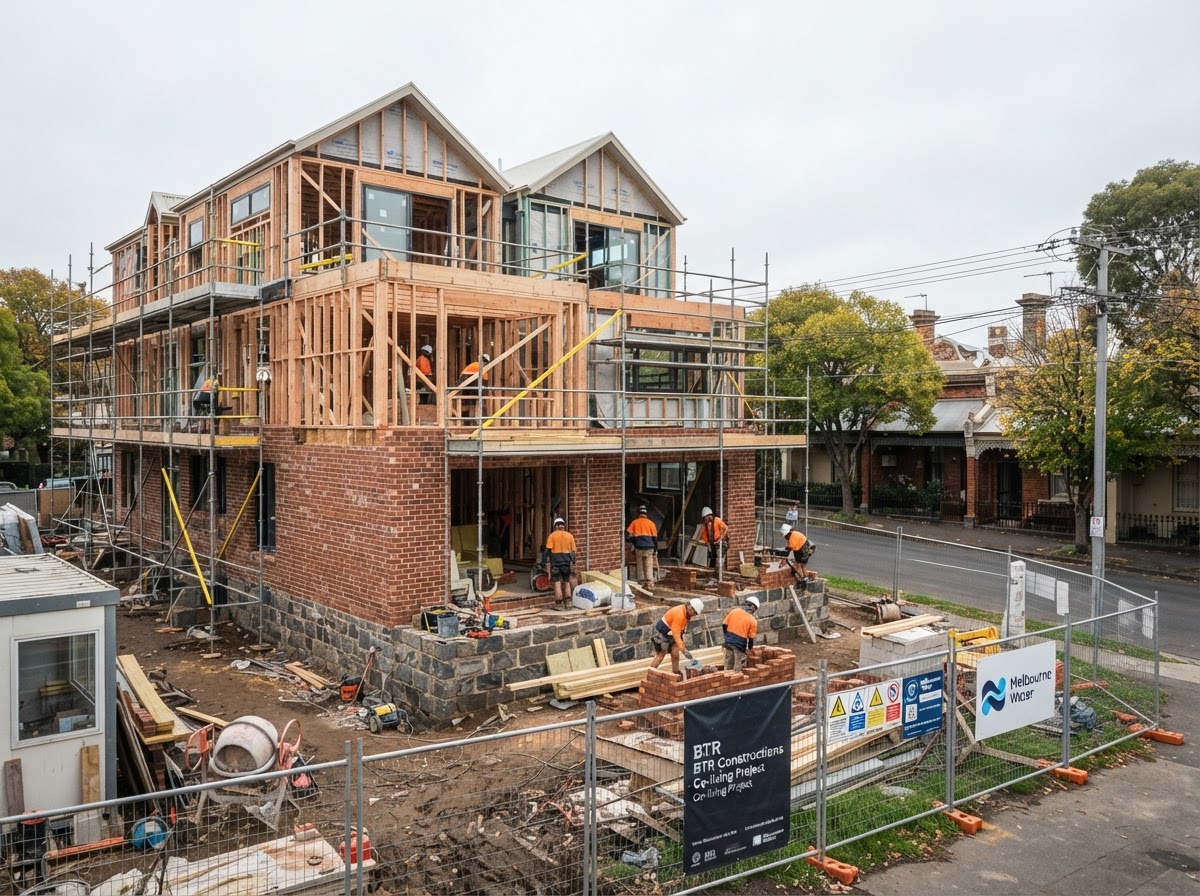
What is a Class 1B rooming house builder?
A Class 1B rooming house builder designs and constructs rooming houses and small co-living developments under the Class 1B classification of the National Construction Code. Because Class 1B carries specific requirements for fire safety, egress, room sizes, sanitary facilities and accessibility, the builder must understand the classification from the outset — resolving it in the design rather than retrofitting it during approvals.
What is Class 1B?
Class 1B is a building classification under the National Construction Code. It covers boarding houses, guest houses and hostels of a limited scale — and it is the classification most commonly applied to rooming houses and small co-living developments. It carries specific requirements for fire safety, egress, room sizes, sanitary facilities and accessibility that differ from a standard Class 1a dwelling.
For a rooming house, Class 1B governs the fire safety, egress, separation, room sizes, sanitary facilities and accessibility of the building. These requirements are not optional add-ons; they shape the plan, the specification and the cost from the outset.
Requirements can vary depending on the site, council, planning controls and proposed use. Our team coordinates with the relevant consultants and authorities to confirm the classification and requirements that apply to each project.
Class 1B rooming house requirements.
The classification changes more than people expect — these provisions shape the design from day one.
Smoke detection
Interconnected smoke alarm systems to suit the classification and occupant count.
Egress paths
Safe, clear evacuation routes from every room and shared area.
Fire separation
Separation between rooms and between the building and boundaries to the required standard.
Room sizes
Minimum floor areas, ceiling heights and ventilation for lettable rooms.
Sanitary facilities
Bathroom and kitchen facility ratios for the number of occupants.
Accessibility
Accessible entries, circulation and facilities to the applicable standard.
Who is involved in a Class 1B build.
A Class 1B rooming house is not a standard residential build. It requires a coordinated team of consultants.
Building surveyor
Confirms the design and construction satisfy the NCC requirements for the Class 1B classification.
Planning consultant
Navigates the planning permit, zone, overlay and council policy that apply to the site.
Fire safety engineer
Resolves separation, detection and egress provisions for the scale of the building.
Acoustic consultant
Addresses sound transmission between rooms and to boundaries where required.
Building approval for a Class 1B rooming house
A Class 1B rooming house requires a building permit and certification, separate from the planning permit. A building surveyor confirms the design and construction satisfy the NCC requirements for the classification. Because the requirements are specific, the design should be developed with the classification in mind from the start — resolving room sizes, egress and fire separation in the plan rather than retrofitting them later.
Rooming houses in Victoria must also be registered and meet prescribed minimum standards for rooms, facilities and management. The registration and compliance pathway runs alongside the building approval, and early coordination avoids costly rework.
Class 1B rooming house builder FAQs.
What is a Class 1B rooming house builder?
A Class 1B rooming house builder designs and constructs rooming houses and small co-living developments under the Class 1B classification of the National Construction Code. Because Class 1B carries specific requirements for fire safety, egress, room sizes, sanitary facilities and accessibility, the builder must understand the classification from the outset — resolving it in the design rather than retrofitting it during approvals.
Are all rooming houses Class 1B?
Most rooming houses in Victoria fall under Class 1B of the National Construction Code, but the correct classification depends on the use, scale and configuration. Some larger or differently-operated models may fall under other classes. Confirm the classification with a building surveyor early.
What fire safety does a Class 1B rooming house need?
Class 1B requires interconnected smoke alarms, appropriate egress paths and fire separation between rooms and to boundaries, sized for the number of occupants. The exact provisions depend on the scale and layout of the building.
Do Class 1B rooming houses need to be accessible?
Yes. Class 1B includes accessibility provisions for entries, circulation and facilities. The extent depends on the scale of the building and the applicable standard at the time of approval.
What approvals does a Class 1B rooming house need?
Typically a planning permit (because a rooming house is a defined use), a building permit and certification to Class 1B, and rooming house registration. Requirements vary by site, council, zone and overlay, so early engagement with the relevant authorities is essential.
Build a compliant Class 1B rooming house.
Class 1B shapes the rooming house from the first sketch. Assess your site and the classification that applies before you commit.
Assess Your Property →